Water often looks effortless in a landscape photograph. A reflective surface, a runnel, a fountain, a stream. Stone, planting, shade and people complete the image.
In a real project, however, water is never only the visible surface.
Its source, flow rate, pressure, filtration, drainage, overflow strategy, slip risk, maintenance access, energy use, replacement parts and long-term operator are also design decisions.
Putting three very different landscapes side by side led me back to the same question: when we design water, what are we actually designing?
Versailles answers through scale. The Diana Memorial Fountain answers through the point where people meet the system. Cheonggyecheon shows how an apparently natural urban landscape can also be continuous infrastructure.
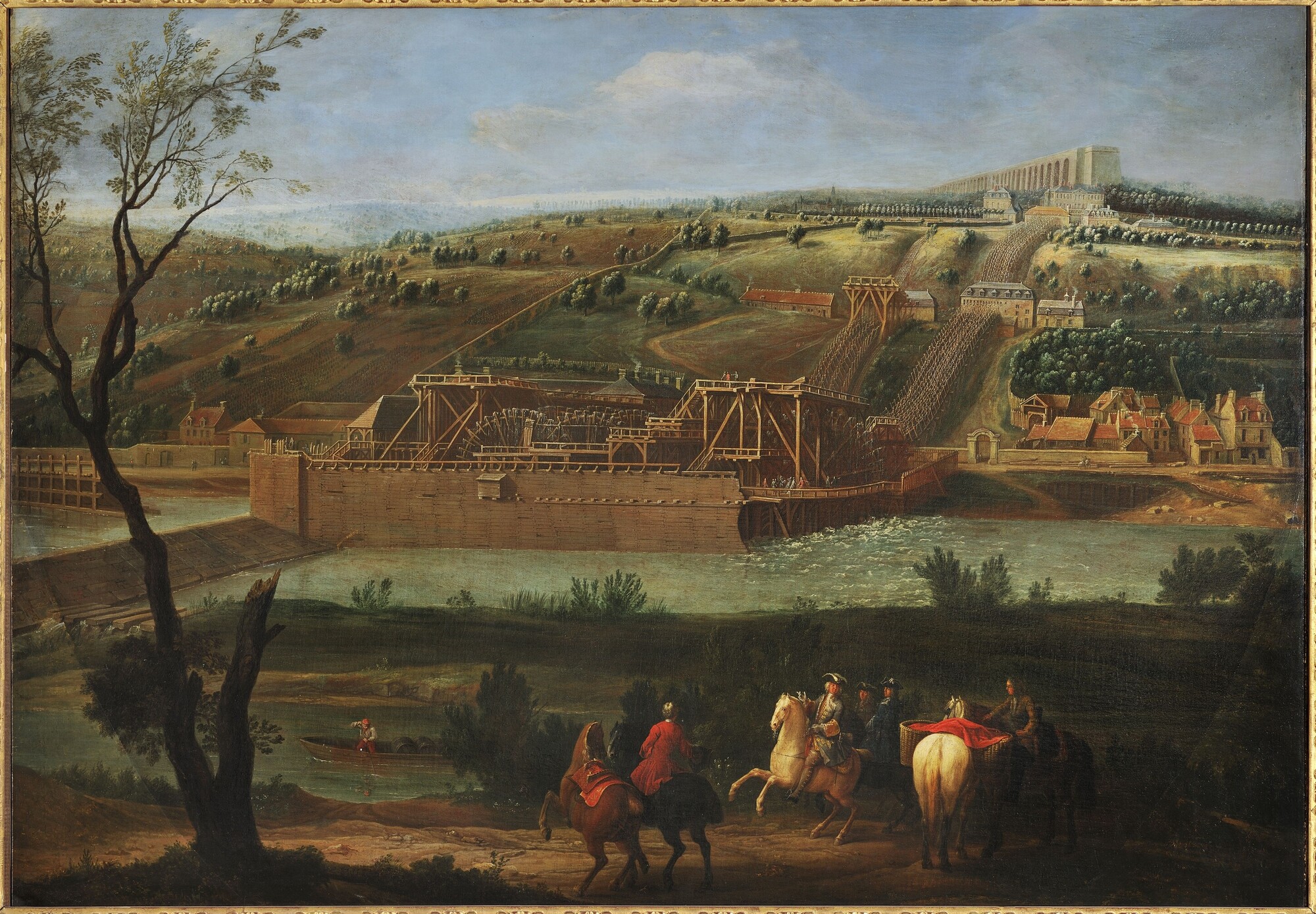
Versailles: the image depended on finding the water first
The gardens of Versailles can read today as an almost perfect image of controlled water. The official history of the estate starts with a much more useful contradiction: despite being built on marshland, Versailles suffered from a lack of water.
As Louis XIV commissioned more numerous and complex fountain effects, supplying them became an engineering project in its own right.
The most spectacular response was the Machine de Marly, developed to move water from the Seine toward the royal water network. Château de Versailles records describe an extraordinary system of large water wheels, pumps and conveyance infrastructure, built with the labour of up to 1,800 people.
The operational layer has not disappeared. The estate states that today’s underground network still contains about 35 kilometres of pipework, combining historic operating methods with modern closed-circuit pumps.
The useful lesson is not a sensational claim about how much water Versailles “wasted.” It is more fundamental: the design ambition created an infrastructure requirement, and the two had to be designed together.
Diana Memorial Fountain: user behaviour is part of the system
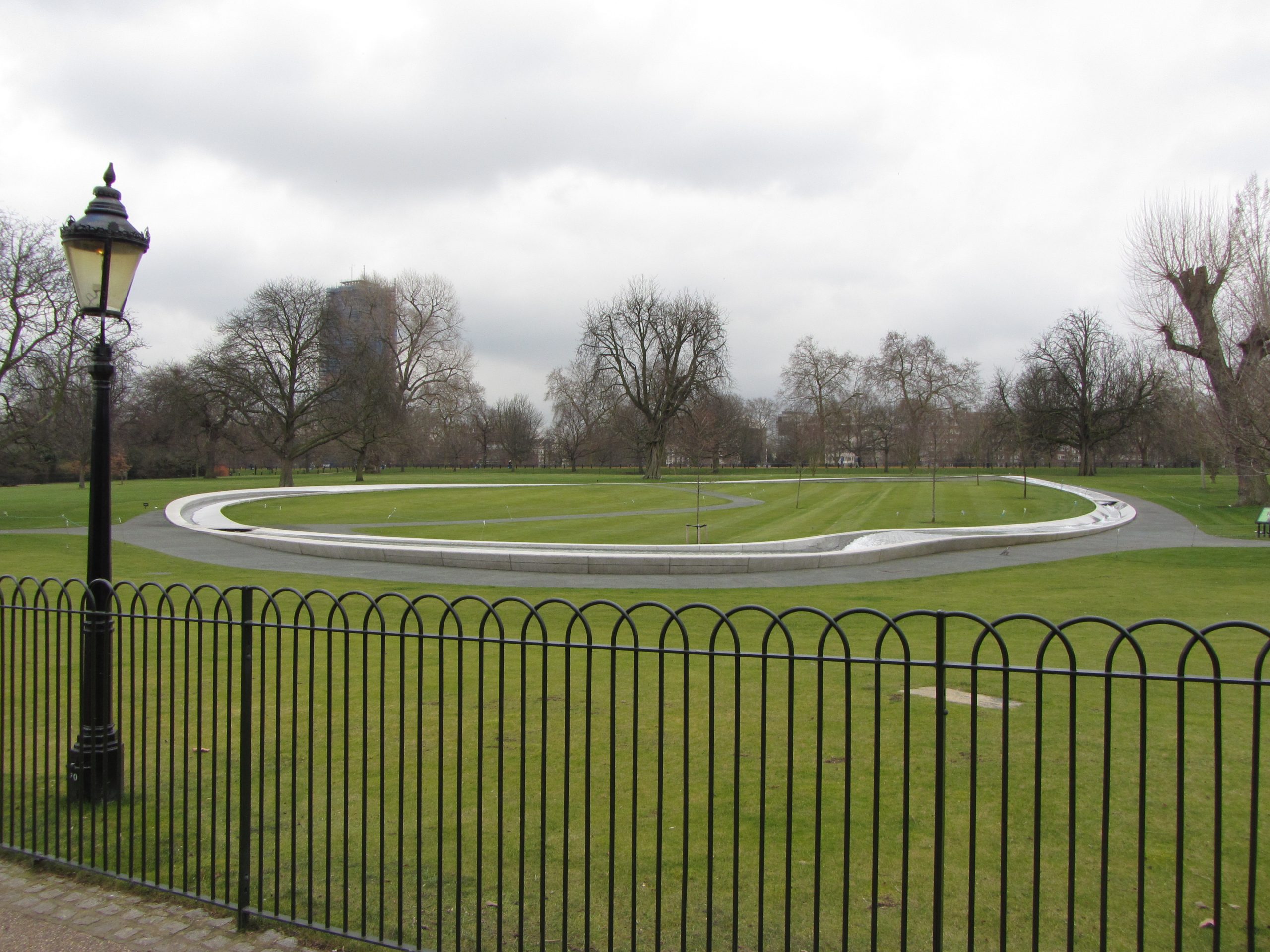
London’s Diana, Princess of Wales Memorial Fountain brings the question closer to the body.
The Royal Parks describes a memorial intended to express openness and accessibility. Visitors can approach the water, sit at its edge and cool their feet. The water course is formed from 545 pieces of Cornish granite and deliberately produces different flow textures along the route.
That direct contact was both the strength of the concept and its real-world test.
Soon after opening in 2004, slips and injuries, together with leaves blocking parts of the water system, led to closures and changes in the way the memorial was managed. That history does not make the project a simple “failure.” It shows how quickly assumed user behaviour, visitor volume and environmental debris can become design inputs.
And the operational question is not only historical. On 1 July 2026, The Royal Parks reported a major fault in Hyde Park’s water system that prevented the fountain from running and required a safety closure.
A tactile water landscape therefore includes more than its form: surface texture, capacity, debris, safe shutdown and maintainability all become part of the design.
Cheonggyecheon: restoration and infrastructure at the same time
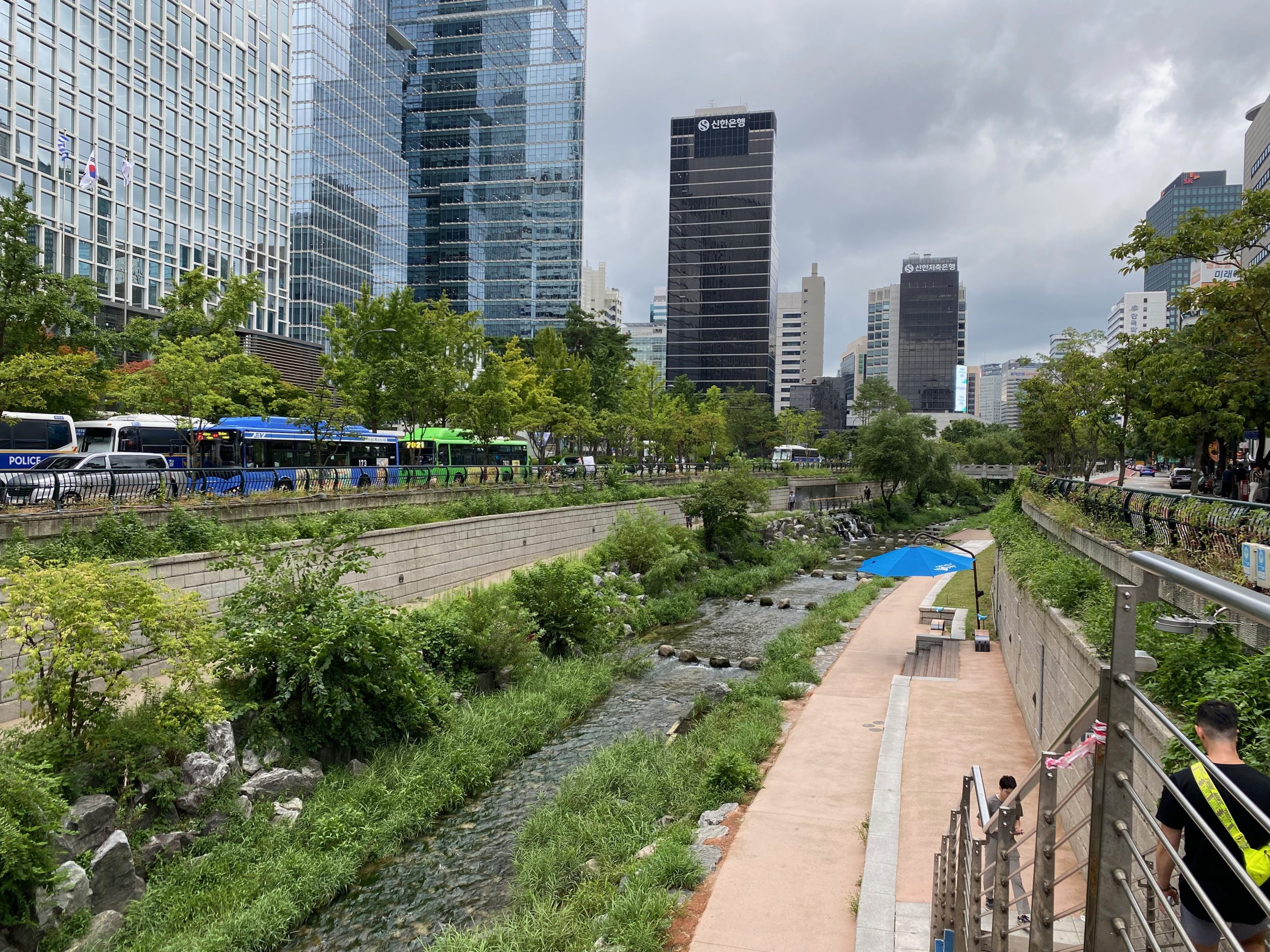
Cheonggyecheon in Seoul operates at another scale entirely.
Seoul Metropolitan Government records the 2003–2005 restoration as a 5.84 km central project with a 2005 cost of KRW 386.739 billion. The current Seoul Facilities Corporation page lists 40,000 m³ of daily water discharge as part of the managed stream infrastructure.
I do not find that number useful as a “gotcha” proving that the stream is somehow fake. Cheonggyecheon has documented public-space, environmental and mobility benefits. At the same time, a 2019 systematic review synthesising 86 studies concluded that it is difficult to confirm the project’s sustainability as a single proposition: many environmental, economic and equity findings remain mixed or unclear.
Those statements can both be true.
Cheonggyecheon can be a successful public landscape and a continuously operated water system. The better professional question is not “natural or artificial?” It is: what performance is being produced by which system, and can that system be sustained over its life cycle?

Good projects do not have to hide the machinery
That is why I do not want to look only for failure stories.
Gardens by the Bay makes the operational layer unusually legible. Its sustainability material explains how the cooled conservatories use a suite of systems designed to reduce energy consumption by about 30% compared with conventional cooling. Its FY2024/25 reporting goes further: more than 410 physical and virtual electricity meters support real-time monitoring, while a chiller optimisation project delivered about 1.1 GWh of energy savings — a 20% reduction against the agreed baseline.
Here the machinery is not an embarrassment behind the image. It becomes a measured layer of design performance.
The questions move upstream
For me, this changes the questions worth asking at concept stage.
Before drawing water, I want to know:
- Where does it come from, and what treatment or quality conditions does it require?
- What changes between normal operation and the worst credible rain, blockage or failure?
- How will people touch, cross or sit beside it, and under what surface/flow conditions?
- Can a maintenance team actually reach the filters, pumps, valves and drains?
- How will water and energy use be measured?
- Who replaces the specialist part in year ten, and from which operating budget?
- Do the plan, visualisation and presentation reveal these dependencies — or only the finished image?
For design-build, hospitality and outdoor-focused teams, these are expensive questions to leave until tender or construction. The concept, 2D plan, planting/material logic and client-facing presentation need to carry the same operational reality.
A strong landscape image still matters. But long-term performance is often decided by the parts we rarely photograph.
The water we see is only half the landscape. The other half is the system that keeps it working.
Sources / Further Reading
Château de Versailles — Water at Versailles — Versailles water-supply constraint, the Machine de Marly and the current hydraulic network.
The Royal Parks — Diana Memorial Fountain — Design/visitor information and the 1 July 2026 water-system fault.
Seoul Metropolitan Government — Cheonggyecheon — Restoration period, 5.84 km scope and 2005 project cost.
Seoul Facilities Corporation — Cheonggyecheon — Current operating/facility data; 40,000 m³ daily water discharge.
Sustainable Cities and Society (2019) — Systematic review synthesising 86 studies on Cheonggyecheon sustainability.
Gardens by the Bay — FY2024/25 — Smart metering and chiller-optimisation energy performance.