When we picture a sustainable city, the image is usually familiar: more trees, parks, bicycle lanes, energy-efficient buildings and fewer cars. All of these matter. But while taking Greening the Economy: Sustainable Cities, the question that became more useful to me was not how many of these elements a city has, but how they work together.
The course frames sustainable urban transformation through the relationships between urbanization, decarbonization and sustainability, using systems thinking as a way to understand cities. Governance and planning, innovation and business, and lifestyles and consumption may appear as separate topics, but the course repeatedly connects them. That shifted my own reading of sustainability away from a checklist of “green features” and toward a question about how the city actually operates as a system.
A sustainable city is not a list of objects, but a system of relationships
A city can ask people to drive less. But if safe cycling connections are missing, public transport is difficult to access, or everyday needs are spread across long distances, expecting behavioral change from individuals alone has obvious limits. In the same way, the existence of a park tells us little about how that space performs for climate adaptation, stormwater or biodiversity.
The design question I find more useful is this: What does the city make easy, what does it make difficult, and which processes does it genuinely make room for? A cycle route that becomes unsafe at a junction loses continuity. A rain garden treated as decoration may not deliver the expected water-management performance. A green space assessed only by area can hide questions of maintenance, access, shade, water and habitat.
Amsterdam: changing the conditions instead of only asking people to cycle
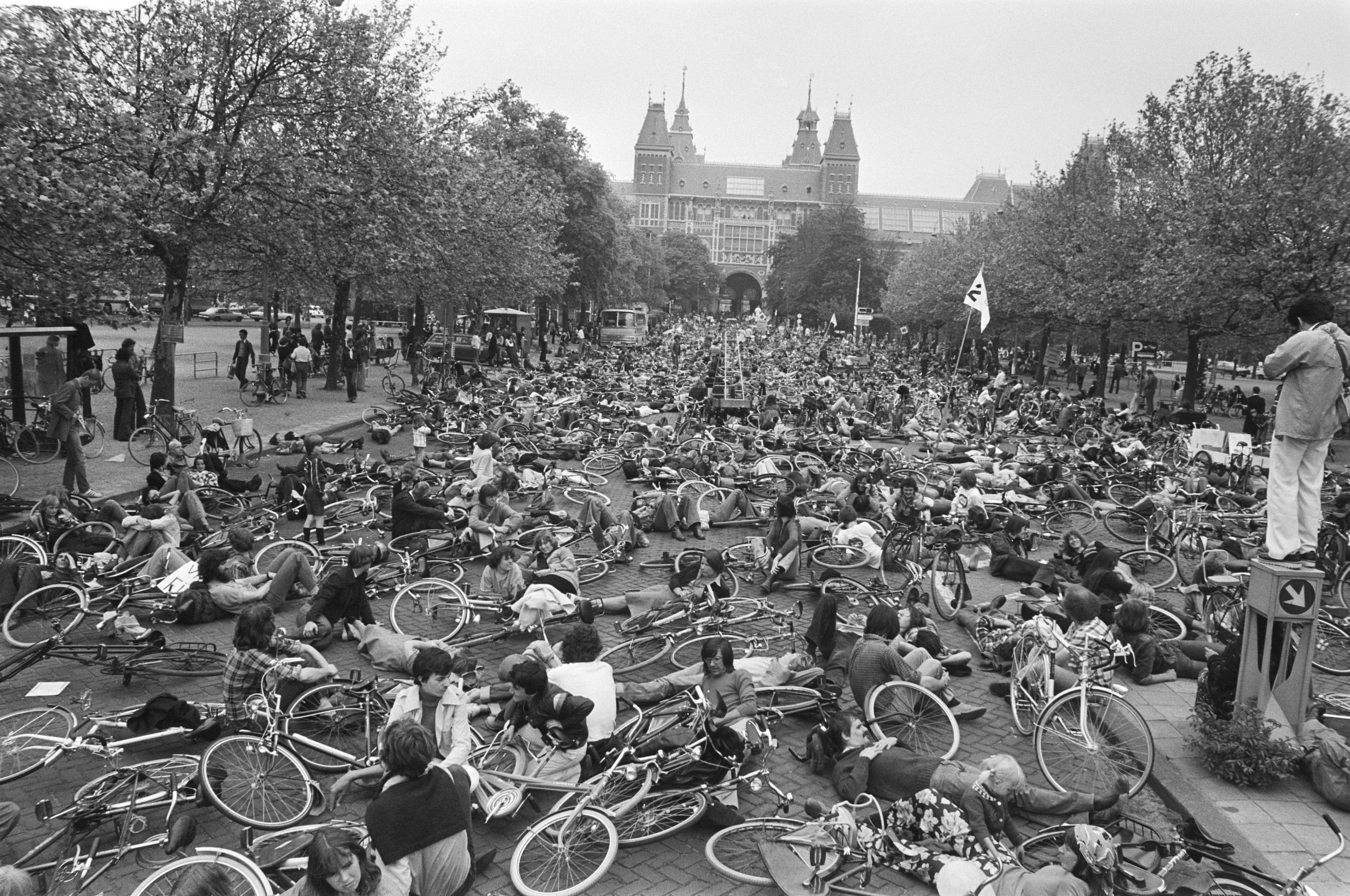
It is easy to associate Amsterdam with bicycles today. The city’s own historical account, however, shows that cycling came under serious pressure during the post-war period of motorization. As car traffic grew through the 1950s and 1960s, planners increasingly treated cycling as a declining mode. In 1970, 114 people were killed in traffic in Amsterdam; according to the municipal history, a significant share of the victims were cyclists. Today’s cycling culture was not an inevitable outcome.
One detail shows how contingent the transition was. A proposed four-lane road through the Nieuwmarkt/Lastage area was rejected by the municipal council on 2 February 1972 by 22 votes to 21. Social movements then pushed traffic safety and urban liveability further into public debate. On 4 June 1977, at least 9,000 people took part in the Amsterdam Fietst demonstration.
Yet it would be misleading to say that protests happened and the city simply changed. Amsterdam’s own history describes how, from 1978 onward, the main cycling network was developed through thousands of interventions over many years: safer junctions, traffic calming, two-way bicycle access on streets where car traffic was one-way, quieter or car-free streets, and new connections. Social pressure, municipal policy and long-term technical implementation worked together.
Nor is that system “finished.” Amsterdam’s current cycling history points to new problems created by high bicycle volumes and users travelling at different speeds, including e-bikes. Sustainability appears here not as a completed ideal, but as infrastructure that has to be adjusted as patterns of use change.
What I take from Amsterdam is not that design alone determines behavior. It is that there is a real difference between telling people to behave differently and creating physical and policy conditions in which a different behavior becomes safe, accessible and practical in daily life.
Can we ask the same question about rainwater?
The same systems lens becomes even more concrete with rainwater. Conventional gray drainage often focuses on collecting and conveying water through gutters, drains, pipes and storage structures. Green and blue-green infrastructure can manage rainfall closer to where it falls. Permeable surfaces, rain gardens, bioswales, green roofs, rainwater harvesting and urban trees are some of the tools available.
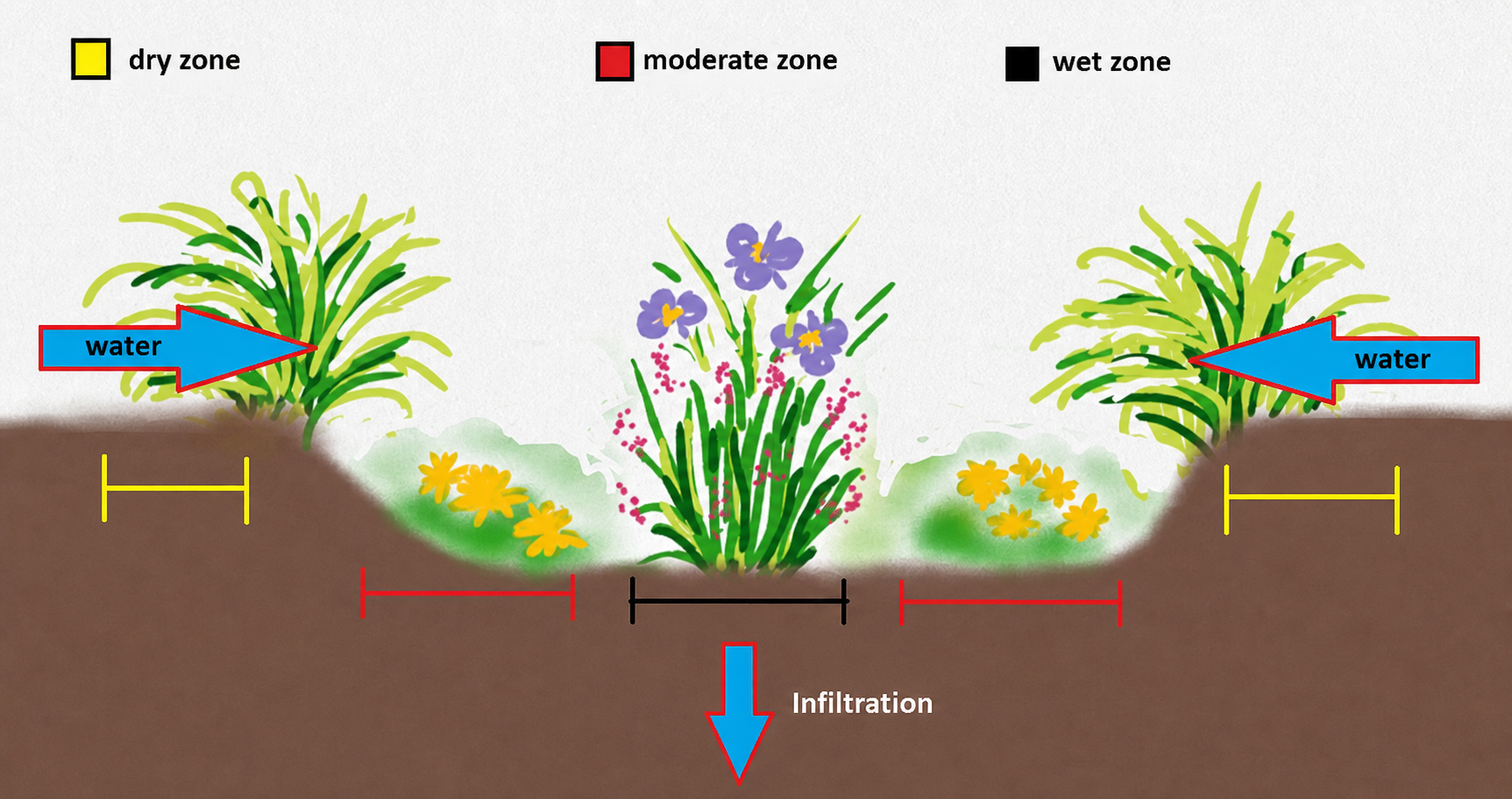

The Dutch Waterbeleid 21e eeuw approach expresses the logic in a simple sequence: vasthouden → bergen → afvoeren — retain, then store, and only then discharge in a controlled way. I do not think this should become a “gray infrastructure bad, green infrastructure good” opposition. The US EPA also stresses that gray and green infrastructure can work together. The real design problem is deciding where water can be retained, stored or reused, and where it ultimately needs to be released safely.
There is an important technical limit: infiltration is not appropriate everywhere. Soil and groundwater conditions, permeability, seasonal groundwater levels, previous land use and potential contaminant sources all matter. In some locations, filtration or evapotranspiration may deserve more emphasis; in others, a liner, underdrain or controlled discharge may be safer. Sustainability is therefore less about producing something that looks green and more about matching the system response to actual site conditions.
Amsterdam’s current rules show how this thinking can become measurable. Under the relevant standard regime in the current Omgevingsplan, developed surface area is required to provide at least 60 L/m² of rainwater storage, with discharge-rate and 60-hour emptying conditions also defined. The rule has a defined scope and exceptions, so it should not be simplified into “every building in Amsterdam has the same requirement.” The city’s 2026 budget also links sewer, green-space, road and spatial-development investments to rainfall and climate resilience.
The subject has expanded beyond heavy rain. In 2024, the Amsterdam Rainproof network broadened into Amsterdam Weerproof, bringing heat, drought and flood risk into the same climate-adaptation agenda. A “stormwater project” therefore becomes a wider relationship between public space, planting, buildings, infrastructure and climate risk.
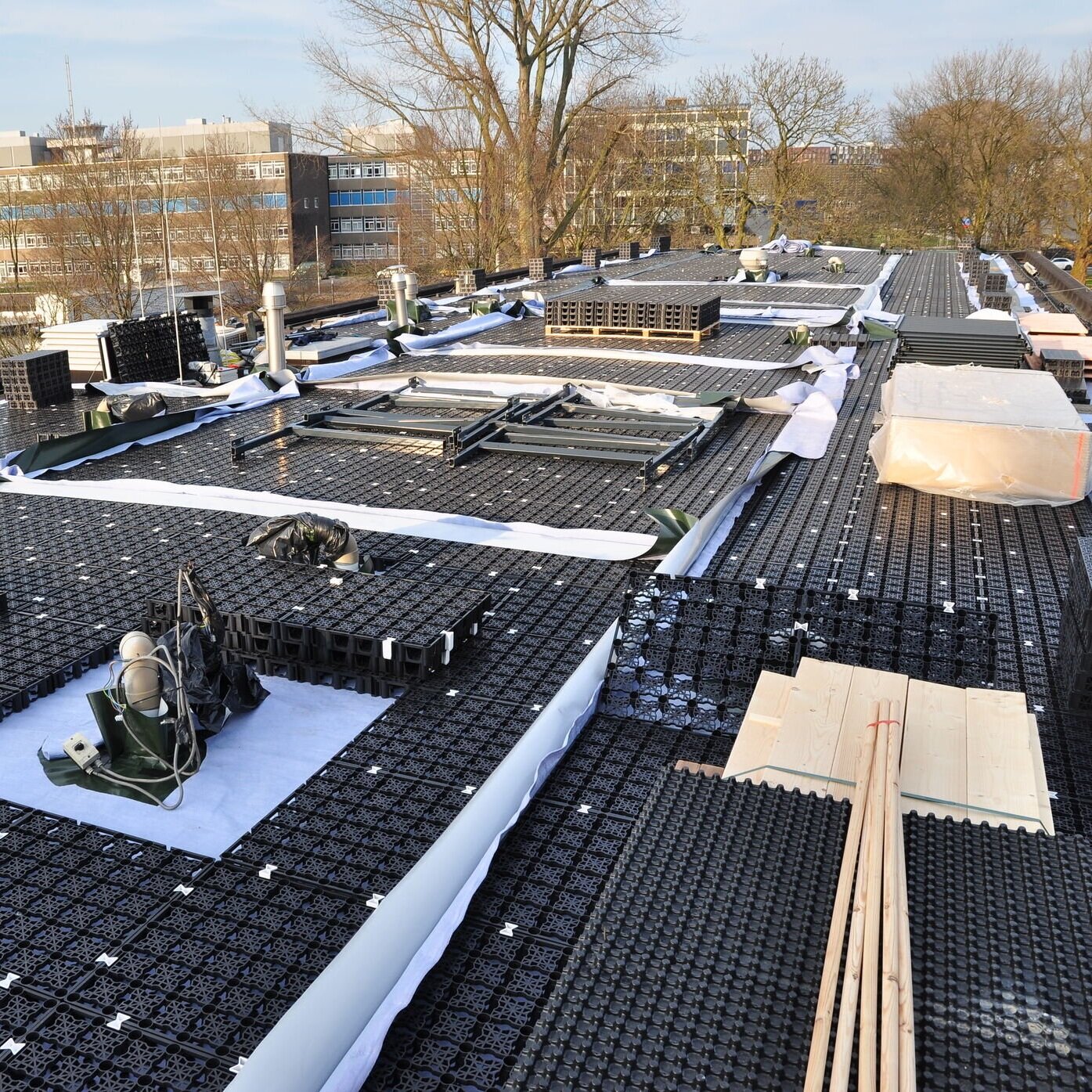
The RESILIO project makes that relationship visible. Working with a 10,000 m² network of blue-green roofs in Amsterdam, it exposes a design trade-off between storing water and supporting planting, biodiversity and evaporative cooling. Before extreme rainfall, empty storage capacity is valuable; during dry periods, retaining water for plants can also matter. Sustainable infrastructure is not always about maximizing one performance indicator, but about managing competing needs within the same system.
From individual projects to governance cycles
A good cycle route, rain garden or blue-green roof can be valuable, but a collection of good projects is not yet a citywide sustainability strategy. This is where the GreenClimateCities (GCC) framework becomes relevant. ICLEI’s current methodology organizes 9 steps into three phases — Analyze, Act, Accelerate — and links them with a Measuring, Reporting and Verification approach.
Urban-LEDS is one historical program context for this work. Its second phase ran from 2017 to 2021, supported 72 local governments and 8 national governments, and worked on developing or updating low-emission development strategies and related climate action plans in 17 cities. Those figures do not by themselves prove climate outcomes; they show why scaling ideas requires governance, technical capacity, finance and monitoring.
Vancouver offers a useful measurement counterpoint. Its final Greenest City 2020 update reported that 8 of 18 targets were achieved, while progress was recorded across all targets. I do not read that ratio as a verdict of success or failure. The value here is that the targets were measurable enough for unfinished work to remain visible.
What changed for me as a landscape architect
After the course and the research that followed, the idea of a sustainable city feels less connected to the question, “How green does this look?” I am more interested in what a space actually does within the wider system.
A tree can influence shade, microclimate and how rainfall meets the ground. A rain garden can be planting and water-management infrastructure at the same time. A pedestrian or cycling connection can change which mobility options become practical in everyday life. UN-Habitat’s 2025 guidance on nature-based solutions similarly places green infrastructure, urban forests, wetland restoration, green corridors and biodiversity-sensitive planning inside a broader urban and governance context.
That is why I increasingly think of landscape architecture in a sustainable city not as a decorative final layer, but as an infrastructure interface between water, microclimate, biodiversity, movement and public life. It also means resisting the assumption that every solution that looks “green” is automatically sustainable. Performance, location, maintenance, users and relationships with other systems matter at least as much as appearance.
Perhaps what actually makes a city sustainable is not how many “green” elements it contains, but how it makes room for people, water and natural processes, how it measures those relationships, and how it adjusts the system as conditions change.
Sources and further reading
- Lund University / Coursera — Greening the Economy: Sustainable Cities: https://www.coursera.org/learn/gte-sustainable-cities
- Municipality of Amsterdam — How Amsterdam became a bike city: https://bikecity.amsterdam.nl/en/how-amsterdam-became-a-bike-city/
- Stadsarchief Amsterdam — Amsterdam Fietst: https://www.amsterdam.nl/stadsarchief/stukken/verkeer/amsterdam-fietst/
- Rijksoverheid — Waterbeleid 21e eeuw, vasthouden, bergen, afvoeren: https://www.rijksfinancien.nl/memorie-van-toelichting/2010/OWB/XII
- US EPA — Green and Gray Infrastructure Research: https://www.epa.gov/water-research/green-and-gray-infrastructure-research
- US EPA — Green Infrastructure and Groundwater Protection: https://www.epa.gov/green-infrastructure/green-infrastructure-and-groundwater-protection
- Municipality of Amsterdam — Omgevingsplan / hemelwaterberging: https://lokaleregelgeving.overheid.nl/CVDR696291
- Amsterdam Weerproof: https://weerproof.nl/wat-is-weerproof/
- RESILIO Amsterdam — Final Report: A roof journey: https://resilio.amsterdam/wp-content/uploads/2022/03/Final-Report-RESILIO.pdf
- ICLEI — GreenClimateCities: https://iclei.org/greenclimatecities/
- UN-Habitat — Accelerating Integrated Urban Climate Action: Urban-LEDS Phase II: https://unhabitat.org/accelerating-integrated-urban-climate-action-achievements-and-impacts-of-the-urban-leds-phase-ii
- City of Vancouver — Greenest City Action Plan final update: https://vancouver.ca/files/cov/2021-greenest-city-action-plan-final-update-presentation.pdf
- UN-Habitat — Integrating Nature-based Solutions into Urban & Territorial Planning: https://unhabitat.org/integrating-nature-based-solutions-into-urban-territorial-planning